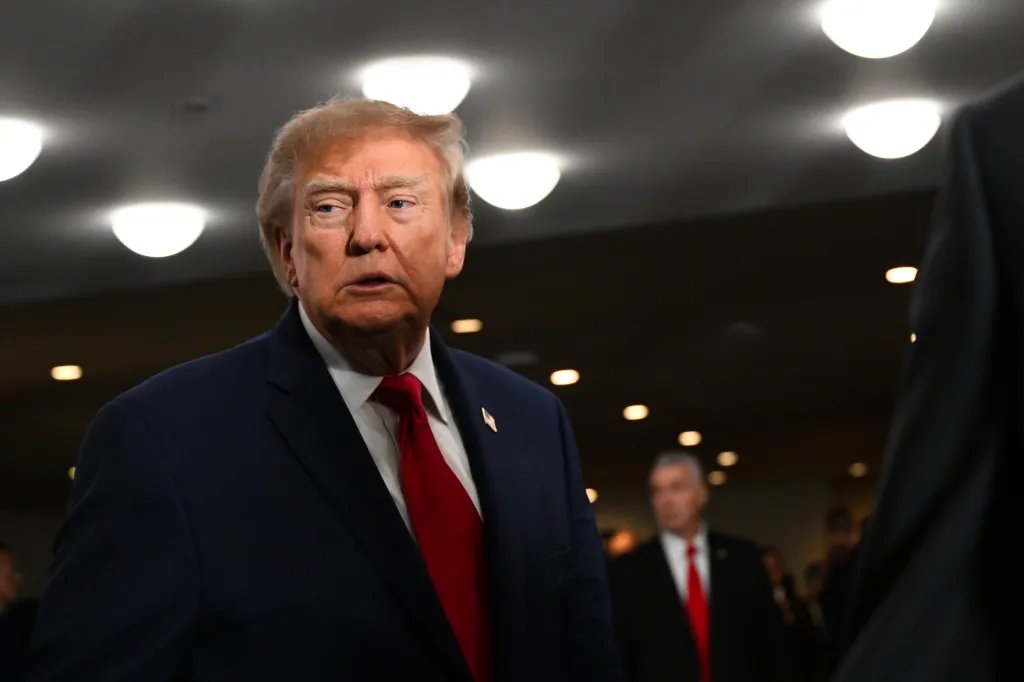
A federal judge has again dismissed Donald Trump’s $10 billion defamation suit against The Wall Street Journal over reporting on a letter he sent Jeffrey Epstein for his birthday in 2003.
U.S. District Judge Darrin P. Giles wrote in his opinion that Trump’s lawsuit “falls short of pleading actual malice. In fact, the allegations of malice are conclusory, vague, sometimes inconsistent with the paragraph, and often irrelevant to whether the defendants knew or should have known that the statements allegedly made in the paragraph were false.”
Trump sued the Journal as well as a series of other defendants, including Rupert Murdoch, after it published an article in 2025 reporting on the contents of an incriminating letter bearing Trump’s name and included in a “birthday book” compiled for Epstein’s 50th birthday.
In its story, the Journal reported that the letter “consists of several lines of typed text framed by the outline of a naked woman, which appears to have been hand-drawn with a heavy marker,” adding that “a pair of small arches depict the woman’s breasts, and the future president’s signature is a squiggly ‘Donald’ below his waist, mimicking pubic hair.”
Trump has claimed that he has not written this letter. The article included Trump’s denial that he had written the letter and that he was preparing to sue. Parent Dow Jones, News Corp CEO Robert Thomson and journalists Khadija Safdar and Joseph Palazzo were also named in the lawsuit.
The judge initially dismissed Trump’s case, concluding that it failed to allege actual malice, but allowed it to be amended. However, the judge’s latest ruling is with prejudice, meaning the same claim cannot be filed again.
Trump wants to appeal against this decision.
A spokesperson for the president’s legal team said that the President “will continue to move forward in his powerhouse lawsuit against the Wall Street Journal and all other defendants. The President will continue to hold those who mislead the American people with fake news accountable for their actions.”
In his opinion, the judge began with a quote from Justice Lewis Brandeis in his concurring opinion in The New York Times v. Sullivan, a landmark 1964 Supreme Court decision that set the precedent for public figures seeking defamation claims. It established the standard that public figures must prove actual malice, or that a media outlet published a story with knowledge that it was false or that it was done with reckless disregard for the truth.
Brandeis wrote, “Those who won our independence believed…that public discussion is a political duty; and that it should be a fundamental principle of American government.”
more to come.