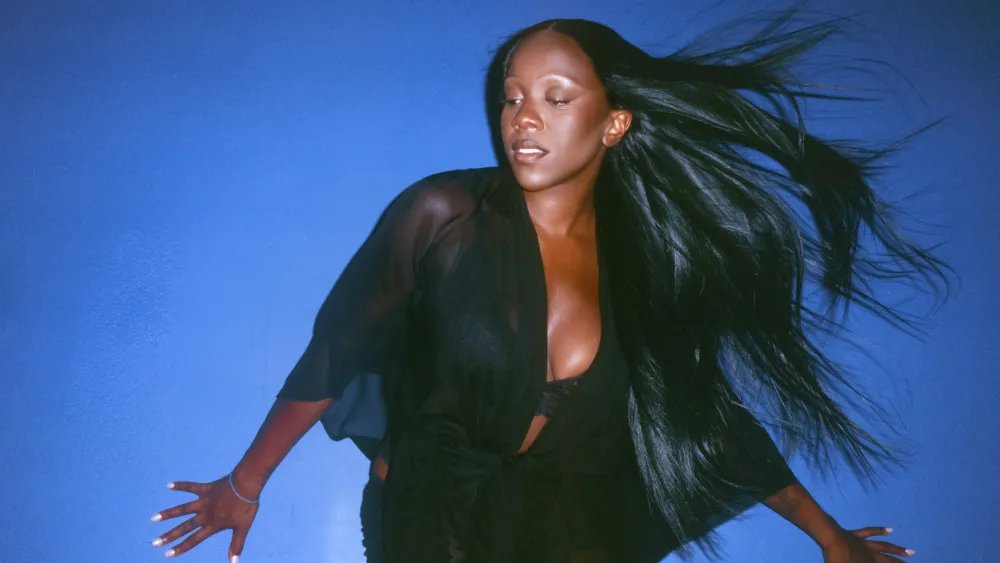
When she began work on her sophomore album, “I Think I Spoke Too Soon”, Rachel Chinouri reverse-engineered the entire process. The British singer-songwriter, who took the world by storm with her 2024 debut “What a Devastating Turn of Events,” found a large piece of paper and wrote down the topics and experiences that have shaped who she has become over the years. “We had a lot of song titles, but no songs,” she explains. Diversity on Zoom just days before the record’s release. “I saw a picture, but my vision was blurry. I was wearing glasses with the wrong prescription. And it’s like, I could see it, but I was like, why can’t I see this thing properly? It was really cool to tie it all together.”
Chinouriri eventually created “I Think I Spoke Too Soon” (released today), a concept album filtered through the lens of a foggy city night. It’s a record that grapples with the indecision and challenges of figuring out the person you want to be, largely substituting the thrusting guitars of “Events” for more synth-driven fare. It makes sense that the first song she wrote was “The Good Fight,” a dreamy, impressionistic thesis for the album where she sings about “friends I hate” and drinks to drown out her loneliness. “Do you like the way you can’t remember tomorrow?” She sings. “Or do I like the taste of sick bile and stomach pain?”
The 27-year-old is equally candid on the album, discussing how she approached it creatively. “It was like performing an autopsy on myself at the same time,” she says. Writing “The Good Fight” made her realize she needed to get sober, which helped her examine the self-destructive and toxic cycle of drinking. On “Broken Chair”, the album’s captivating centerpiece, she looks back at how dire the situation had become as she staggered back home after the last call. She sings, “She’s being thrown in the gutter, it’s getting really hard to love her.” “I’m out of my mind, there’s people looking at me / I wonder what they see.”
“[I was] Analyzing who I was before I turned 26, between 22 and 26, and finding out who I was,” she says. “I hate vomiting. The number of times I’ve sat on the floor vomiting on the streets of London… thank God there’s no recording of me. But what was I doing? It’s by no means the kind of person I am, but I was doing it for fun. It almost made me feel a little sorry for myself.”
Despite the album’s bleak nature, “I Think I Spoke Too Soon”, inspired by artists such as Madonna and Donna Summer, has a musical vibrancy that brings tears to the club. For example, lead single “One Song Away from Crying” is an ’80s synth bop that shines like lights bouncing off a disco ball, where Chinauri feels the walls closing in on her: “I’ve never looked better and I’ve never felt worse,” she sings.
She says, “I come from a family that went through a lot of living as immigrants in Britain, and they dealt with very deep and sad things through laughter or music or things that made them feel happy and joyful.” “Then it’s reflected in my music where I’m like, we’re going to dance through this, but I’m going to tell you the saddest things in these three minutes.”
Over the years, Chinauri has garnered a growing fan base that identifies with his confessional songwriting and personality. During the Los Angeles stop on his headlining “Events” tour last year, he held the crowd in the palms of his hands and encouraged them to tell the person standing next to them that they love them, or to close their eyes and imagine a place of peace. Communicating with their fans is part of the Chinouri experience, so much so that they even have actual conversations with anyone who approaches them for photos.
“I try to normalize myself as much as possible to my fan base because as someone who used to be a fan girl on Twitter even before I became a singer and even when I started becoming a singer, I didn’t think I’d get this far,” says Chinauri, who shares that she once ran a Coldplay fan account. That feeling of online abandonment continues today: Earlier this month, she called out an X user for posting a video where they tore down one of her posters simply because it was next to a poster promoting Adela.
“If I walk down the street and see someone tearing down anything, not just a poster, if I see someone breaking and damaging property, I would just say you’re not a good person,” she says. “It’s just a shitty thing to do. So instead of ignoring it and allowing people to almost cyberbully me, I’m going to admit it and be like, yes, I’ve seen it. And it makes me feel really sad. I’ve put a lot of money and effort into this and it’s not OK. And I’m glad that my fans can at least humanize me in that way because I think the standard thing you’re always told in PR is that anything Don’t say, ignore it. But I guess it makes me feel isolated from my fans. Maybe I’ll change my mind about that when I get older, but I enjoy my fans and the real friendship I have with them, knowing that they can look at me in public and say, hey, I like stuff like that.
Chinauri has come face to face with her fans over the past few years as she tirelessly travels the world. They opened for Sabrina Carpenter’s UK and European “Short N’ Sweet” Tour and Florence + The Machine’s “Everybody Scream” Tour last spring, and headlined their own treks between performances at the Governor’s Ball and Bonnaroo. In late August, she was the only British artist to perform at Olivia Rodrigo’s Daisy Chain Fields Festival in Irvine, California, which Rodrigo chose to describe as a “perfect day”. Next, she will open for Gracie Abrams on her tour in December.
For now, Chinouriri has her fans on her mind, as she counts down the days to the release of “I Think I Spoke Too Soon” and how the record’s message will come across. “My fans have grown, I have grown a lot with my fans and I would like my fans to recognize my growth but maybe [also] They have their own growth,” she says. “I hope that if they’re going through a tough time, [that they] Learn to self-forgive. Self-forgiveness is one of the biggest things I learned through this album. I have done and said this and that in the past there have been so many versions of me that I hate and that someone will perceive me that way for the rest of my life. It used to give me anxiety, but now I feel like, you know what? I forgive myself because I know I am not that person. This is something that is no longer normalized in society. “I hope that my fans who listen to it can recognize that in themselves and then pass that same level of grace on to other people.”