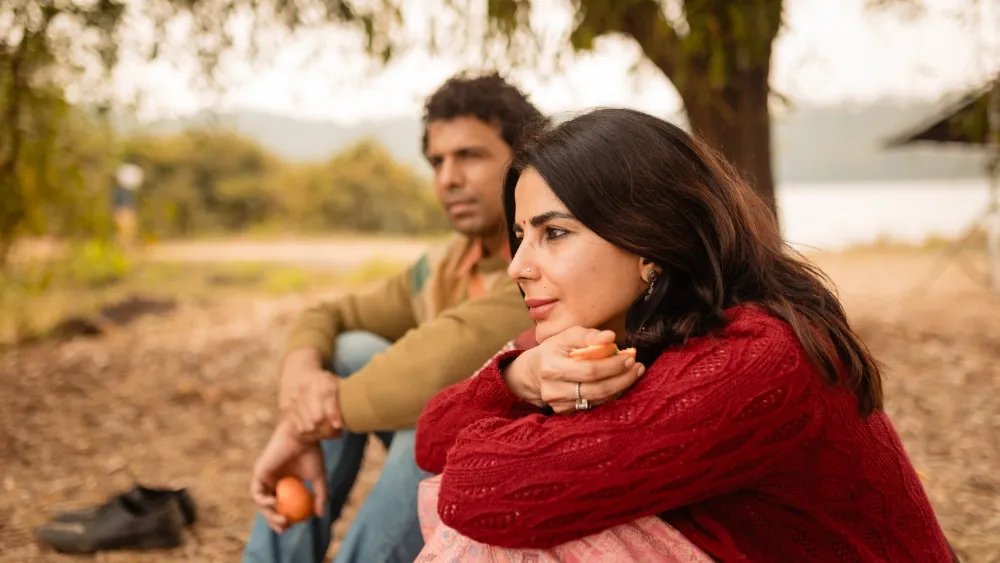
Kirti Kulhari’s debut film as a producer, “Kinare” (“Shores”) will premiere at the 15th Dharamshala International Film Festival (DIFF), opening with Rima Das’s Berlinale-award-winning “Not a Hero”.
This festival will run from October 29 to November. 1 at the Tibetan Children’s Village in Upper Dharamshala, with an online version from 2-9 November.
Written and directed by brothers Akbar Qadri and Azam Qadri, “Kinare” stars Kulhari as Amina, a single woman from a village near Delhi who spends her time taking care of her elderly parents and the family home. Her cousin, played by Azam Quadri, arrives without warning after being away for 15 years, and his visit brings back the events that once divided the family. By the time he left, Amina had made peace with the past. Rajeev Siddharth, Alka Amin and Ravi Taneja complete the cast.
Kulhari produced the film through his banner Kintsukuroi Films, with Abhishek Koka and Mansi Gupte as co-producers.
Kulhari said, “It’s a script that really appealed to me. It’s a simple, heartfelt and subtle film. I find all these adjectives in Iranian films – which I’ve always loved – so when I came across something like this, I knew I had to make it.” “This is exactly the way I wanted to make this movie: independently, make it the way I see it, not the way we all see it collectively.”
Siddharth said that every actor expects a script that gives importance to the words written and also inspires him to explore the space between the words. “And with ‘Kinare’, I got a chance to do the same as an actor. I think the theme of ‘Kinare’ is so universal that whoever watches it will definitely be touched, moved and slightly changed from within after the experience,” he said.
The film’s crew includes cinematographer Arjun Sundaram, music composer Mohan Kannan, editor Bakul Matiyani and sound designer Sanjay Chaturvedi.
The India-Singapore co-production “Not a Hero” will have its South Asia premiere as the festival’s opening night film. It debuted at the Berlinale earlier this year, where it took home the Crystal Bear Special Mention in the Generation KPlus strand and later won Best Indie Film at the Indian Film Festival of Melbourne. It has also played Zlin, Zurich and Busan.
The film focuses on a boy moving from the city to his family’s ancestral village. There he meets a distant aunt, befriends a horse and gets along with a group of local kids, finding a life away from the screen and an adventure he didn’t know he had.
Das is known for “Village Rockstars,” “Bulbul Can Sing,” “Tora’s Husband” and “Village Rockstars 2.” His films have screened in over 150 festivals and have received over 75 awards.
The latest additions to the DIFF lineup also include Don Palathara’s “The Uncertain Principle,” set among young people pursuing careers in cinema in Kochi, and “Cool Ladies Club,” a documentary co-directed by Shilpi Gulati and 10 women from Mumbai’s eastern suburbs who made the film together over 18 months.
Also on the slate are Tanushree Das and Soumyanand Sahi’s Kolkata-set Berlin-debut family drama “Shadowbox,” Rafał Kapeliński’s Poland-Hungary title “Budapest Diaries” and Amy Imanishi’s Western Sahara-set “Nomad Shadow.”
They join titles from the festival’s inaugural series, among them Gurvinder Singh’s Locarno title, the India-France co-production “Rahmat,” which weaves together three stories set in present-day Punjab; “Termites”, a short set in 1990s Old Delhi, is the first fiction film from Oscar-nominated documentarian Shaunak Sen; and Oliver Lax’s Cannes-winning “Sirat.”
The first wave also includes Sompot Chidgasornpongse’s Cannes-debut Thai family pilgrimage drama “9 Temples to Heaven,” Sara Dosa’s Iceland-set “Time and Water,” R. Gautham’s Berlin-booming grief drama “Problematic Family Members” and Dennis Harvey and Lars Loewen’s Irish folk music documentary “Celtic Utopia.” Samreen Faruqui and Shabani Hassanwalia’s documentary “The Ordinary Star” follows Nawazuddin Siddiqui as he studies the real-life living room he used while shooting Dibakar Banerjee’s segment “Star” in the 2013 anthology “Bombay Talkies”.
DIFF was founded by filmmakers Ritu Sarin and Tenzing Sonam. This year’s edition will also run its own fellowship programme, featuring seven fellows trained by Bhutanese director Dechen Roder and Indian independent filmmakers Umesh Kulkarni and Dominic Sangma.