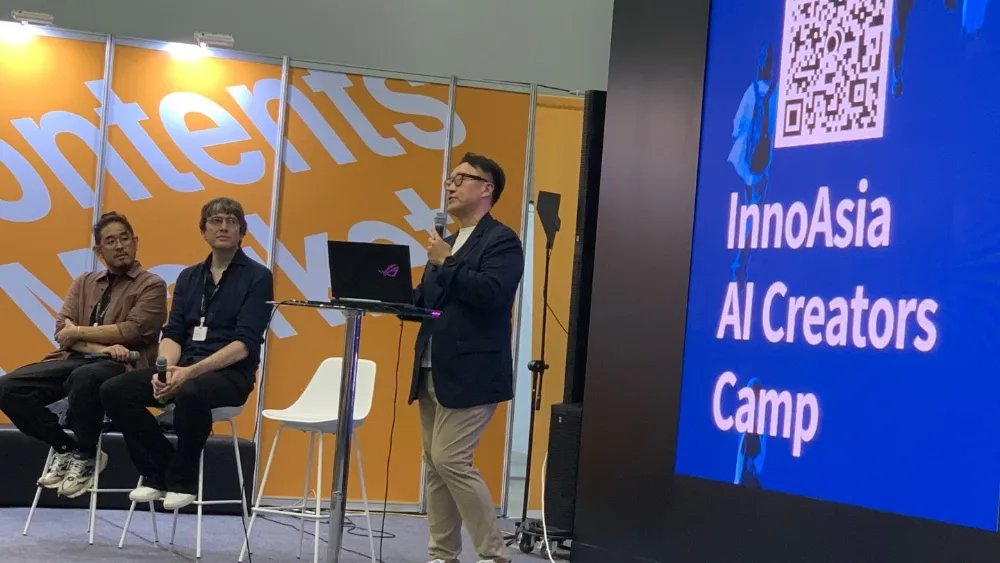
According to VFX veteran Hong Jae Cheol, smaller, AI-native companies running automated pipelines can develop their own intellectual property, while traditional studios retain their advantages in established franchises, production infrastructure, talent, and distribution.
Viscode producer-director Hong, who began his career at Industrial Light & Magic and worked on films such as “Iron Man,” “Transformers” and “Pirates of the Caribbean,” presented his vision at the InnoAsia AI Creators Camp held at the Busan International Film Festival’s Asian Contents & Film Market in Busan on Sunday. “We are moving from using AI to create individual images to using AI as part of the entire production workflow,” he said.
Hong argued that AI is changing production models, while traditional visual effects are necessary to make the generated content usable on screen. He envisioned the future as a hybrid and partnership between AI and human creativity, rather than a wholesale replacement of existing studios.
Hong compared the traditional live-action and VFX process, which involves creating 3D assets, animation, rendering and compositing, with an AI-assisted approach. Later, the actors perform on a controlled set; AI generates environments and visual elements; And VFX artists handle tracking, integration, and finishing. He also outlined current AI applications in VFX, animation and film production, including rotoscoping, cleanup, previs, character design, camera testing and environment creation.
Mark Wachholz, chief creative director of Berlin-based Dreamkite Studios, whose AI films “The Cinema That Never Was” and “Ceremony” have won top awards at AI film festivals, approached the change from the creative side. He described AI co-creation as an invitation to give up some control and allow surprise, calling the process “exploration rather than control” and “discovering rather than knowing.” He also argued that new devices require new ways of thinking rather than applying old methods to new technology.
Climax Studio director Ahn Jaehong, who turned to AI filmmaking after ending his work behind the camera following a hand injury, brought the discussion back to directing and producing. They mapped out the workflow from cues and camera information to visual reference, shot lists, storyboards, character and prop sheets, locations and keyframes. The sequence reinforced one thing the speakers shared: AI can assist in many stages, but filmmakers still need to shape the story, visual design, and final result.
Hong summarized the difference: “AI is just a tool; film is a sequence.” The discussion focused on how that equipment could become part of a connected filmmaking process, with human direction and VFX expertise still determining how its images fit together.