In the months before the end of the American Civil War, Frederick Douglass spoke at the annual meeting of the Massachusetts Anti-Slavery Society in Boston about what would remain after the defeat of the rebellion. “That hostility will not end in a year,” he warned. “It will not end in an era.”
In Ava DuVernay’s new documentary “14th,” constitutional law expert Sherilyn Ifill recalls Douglas’s words from his “What the Black Man Wants” speech. A distinguished lawyer, Harvard University law professor, and former head of the NAACP Legal Defense Fund, Ifill is the closest thing the film has to a narrator. His invocation of Douglass serves as a refrain, which returns again and again to make one point: We are living in one of the eras he predicted.


The Fourteenth Amendment made birthright citizenship the law of the land, ensuring that formerly enslaved people and Born on other American soil – For example, the children of Chinese railway workers – were citizens. But Ifill cleverly explains one of its major failings: against Douglas’s wishes, the amendment did not explicitly protect the right to vote. Douglas predicted that weakening black voting rights would provide an opportunity to strip those rights away for generations from the same people who had fought to maintain slavery.
“14th” looks at history as an essential playbook for the present. We are living amid the expiration of the Voting Rights Act, widespread voter-suppression efforts, and challenges to birthright citizenship by the Trump administration. The message is clear: this is not just history. It is now.
A companion piece to DuVernay’s 2016 documentary “13th,” which examined the constitutional amendment banning slavery through the lens of mass incarceration, “14th” arrives a decade later during the second Trump administration. It is a maximalist journey through American history, guided by leading thinkers including Ifill, Bryan Stevenson, David Blight, and Jelani Cobb; Commentators such as Van Lathan; and politicians including Alexandria Ocasio-Cortez, Jeff Flake and Stacey Abrams. Together they explore how the Amendment changed the country and what is at stake in the continued attack on its guarantees.
Both films share structural and visual DNA. Both rely on a series of talking heads to tell their stories. However, where the “13th” placed its interview subjects against the structures associated with prisons and hard labor, the “14th” sited its experts in libraries, museums, and universities, halls of learning that emphasize the value of expertise at a time when expertise itself is under attack.
An animated five-pointed star represents the five sections of the amendment, with each point gradually fading away as the documentary shows the erosion of its protection. In this sense, perhaps the most successful part of “The 14th” is that it does a real public service. Its first section is also its strongest, providing important information the filmmakers correctly assume many viewers don’t know: who shaped the Amendment, how Reconstruction changed American citizenship, and how many of the values we share with multiracial democracy emerged from the Constitutional Revolution, which occurred not from the Constitution signed in 1787, but after the Civil War.
But “The 14th” has so much to tell us that its refusal to edit more tightly ultimately works against it. More than 50 talking heads appear. DuVernay clearly wants to reach as wide an audience as possible, including progressive advocates, politicians, historians, lawyers, comedians and political influencers as well as conservatives. In this age of hyperpolarization the instinct is understandable. Yet cinematically, the sheer number of interviewees dilutes the power of the strongest voices.
Did we really need Hasan Pikar’s Birkenstocks and wide-leg pants to reach a younger audience? Probably not. By the time Gen Z political influencer Dean Withers appears at the end of the doc to deliver a sleepy soundtrack that seems destined for the cutting-room floor, you start to wonder why DuVernay is even presenting. one more The characters could have been revisited when there were already so many compelling images on screen and perhaps told in a better way.
Even the captions of the themes seem strangely inconsistent. Van Lathan is not identified until his second appearance. The same happens with historians Eric Foner and David Blight. These may seem like minor details, but in a work asking viewers to track dozens of people across several centuries of American political history, they add up to the cognitive disorganization.
Sherilyn Ifill could have solved a lot of this. Of the more than 50 interviewees, hers is the one the documentary can’t help returning to. She’s based on “The 14th,” and one wishes DuVernay had fully committed to her as a narrative guide, because she speaks in a way that’s accessible and engaging. (The study and application of the Fourteenth Amendment has been his life’s work.) If the film had stayed close to him, it might have served as connective tissue to carry audiences through historical turning points and assemble reasons for despair. Instead, she disappears for a while before returning with a Douglas refrain. To absorb and be influenced by this dense material, the wide audience DuVernay wants to reach clearly needs someone to hold her hand. Ifill could have been that person.
The bigger problem is not just the format of the conversation, but also the claustrophobia it creates. One of the most welcome sightings is that of Devon Henry, who was responsible for removing Confederate monuments along Richmond’s famed Monument Avenue after white contractors refused the work. When her sequence began I found myself taking an involuntary deep breath. Suddenly someone was walking. Wandering in space without saying anything. The film opened for a moment. Henry’s sequence shows how powerful documentary can be when its formal choices are as important as its intellectual ideas.
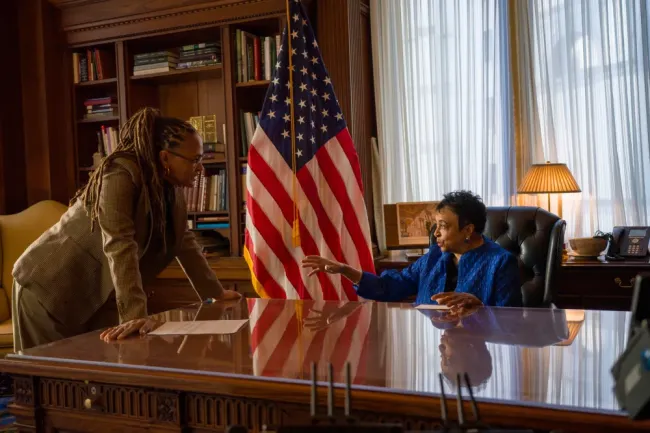
Carla Hayden’s presence at the Library of Congress provides a similar relief. Instead of the camera capturing her face from a side angle – she really gets the hero shot treatment – she greets visitors to one of the country’s great repositories of knowledge. The simple act of watching his movements provides visual relief and words in themselves have the kind of impact they rarely inspire.
However, DuVernay finds inventive ways to bring the past to life, and the archival material ranks among the film’s greatest strengths. Black life during Reconstruction is visible not only in the South, but also in places we might not immediately associate with black citizens, like New Mexico or Boston. The images reflect the extraordinary scope of black efforts to educate themselves, build institutions, and participate fully in citizenship after emancipation. Archival photographs subtly come to life through animation, giving movement to otherwise static images and drawing a visual line from the people who lived through reconstruction to the people living now. The effect is simple but powerful: it’s the past, but these were ordinary people going through their present, just like us.
Comedy provides another effective pressure valve. Clips from standup specials featuring George Carlin, Paul Mooney, Neal Brennan and Hasan Minhaj provide much-needed comic relief about American history. Once Mooney planted the seeds of his joke about how miserable white Americans were after slavery, the images of white mobs at later Confederate memorial groups and lynchings turned into a surreal echo.
Musically, “14th” sounds like a hip-hop rock opera for the end of democracy, or perhaps a plea to save it, fueled by dance moves. For example, when an instrumental version of Kendrick Lamar’s “Alright” came out, I instinctively snapped my fingers and thought, yes. But the documentary moved so fast that there was barely time to understand the allusion. That moment highlights the film’s bigger problem: “The 14th” doesn’t lack for compelling material. There’s still a lot more to it.
About two-thirds into its hour-and-forty-minute runtime, despite a keen interest in the subject matter, I couldn’t absorb much more. The project might have benefited from an episodic structure, perhaps giving each section of the revision room a chance to breathe. (It’s certainly easier for me to make suggestions from outside the realities of documentary financing and Netflix distribution, but formal options contribute to an unnecessarily tiring journey.)
Duvernay has Said She did not want the film to “feel like a drug” and “14th” was energetic, accessible, and often entertaining. But in weaving such a wide net, the film burdens the audience with information to such an extent that it suffocates them. This leads to a certain irony: “The 14th” arrives in an era that already feels overwrought, an era in which concern about politics has become part of daily life. The documentary seeks to move viewers beyond despair, yet its sheer density risks reproducing the very paralysis it hopes to overcome.
Ultimately, Ifill argues that we once again stand at the turning point that the architects of Reconstruction had envisioned. The people emerging from the Civil War had to imagine a radically different country and then write that vision into law. He argues that Americans now have the opportunity and perhaps the obligation to debate in good faith what the next iteration of democracy should be. This may be the most important idea in “The 14th.” This amendment was revolutionary because it envisioned an America that had never existed before.
Which brings us back to Douglass, who spoke in January 1865, just three months before the Civil War ended. In “What the Black Man Wants,” he warned, “When the great leaders of this rebellion are put down,” its leaders may disappear, but “the rising ranks of treason” will remain. That spirit, he said, and Ifill wisely points out, would be passed “from head to son.”
“That enmity will not fade away in a year. It will not fade away in an era.”
More than 160 years later, “The 14th” makes the volatile case that Douglas warned us about still not over. And where do we go from here? It’s up to us.
grade B
“14th” premiered at the 2026 New York Film Festival. Netflix will release it in select theaters on Friday, November 27, and then on Netflix on Friday, December 4.