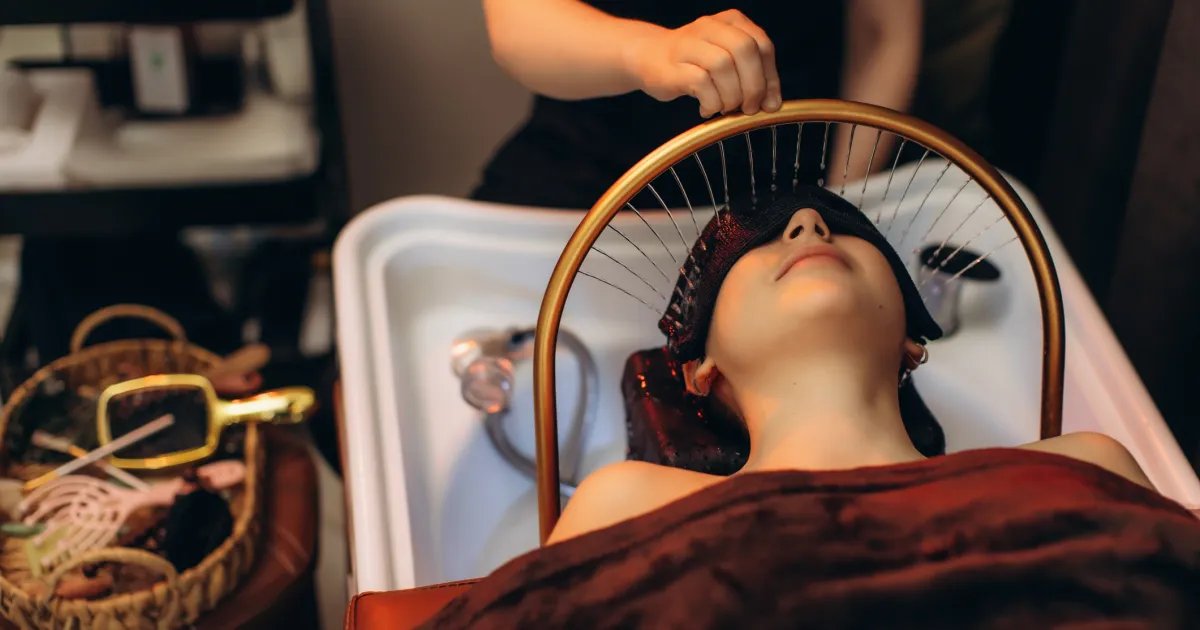
The Japanese head spa has officially taken over your For You page — and now it’s taking over US salon booking waitlists, too. The 90-minute treatment that went viral for its ASMR-coded scalp massage clips, gurgling water and impossibly satisfying foam lather is no longer just content to watch. People are really booking it and places are filling up fast. Here’s everything you need to know before you do.
What is Japanese Head Spa?
It is a 60 to 90 minute scalp and hair treatment that typically includes a scalp inspection, deep cleansing, exfoliation, steam, and a prolonged head, face, and neck massage. Essential oils, conditioning masks, aromatherapy, dim lighting and soft music are standard.
This ritual began in Japanese salons in the 1990s before spreading throughout Asia and the Americas. The global scalp care market is projected to grow significantly over the next decade due to hair fall, stress, pollution, and aging. according to forbes. The viral 2022 social media moment, with its low lights, gurgling water, frothy lather and rhythmic scalp massages, became a hit along with an explosion of ASMR content.
If you’re relying on strategic sectioning, volumizing sprays, and a little wishful thinking to tame thinning hair, beauty buyers have been swearing by a quick fix for years. The cult-favorite Topic Hair Building Fibers instantly provide the look of thicker, fuller hair by hiding sparse areas and bald patches in seconds. Made from natural keratin […]
What happens during a Japanese head spa session?
Each session begins with a calming consultation, followed by a microscopic scalp analysis that examines hair thickness, follicle production, blood flow and signs of dandruff, clogged pores or product build-up.
What comes next depends on what the analysis finds. “If your scalp is dry, we use oil, heat and steam to provide intensive skin care,” Nina BaxmanA Japanese head spa owner in Germany, told mindfood. The heat and steam open up the cuticles so products are deeply absorbed, and sebum plugs or product residue is flushed out with scalp exfoliation using fine sea salt crystals. Traditional ingredients include camellia (tsubaki) oil and rice water. Trichologist Penny James told byrdie The technique “targets and lifts the scalp muscles to stimulate blood flow to the scalp.”
What are the benefits of Japanese head spa?
Head Spa cleanses the scalp, stimulates blood flow, strengthens hair follicles and reduces stress and anxiety. Increasing blood flow can also help in hair regrowth.
The real attraction for many clients is simply where the massage takes place. “Normally, when you go to get a massage, the focus is always like your back, and I always want to have more of a massage on my head, especially my neck, my face. When I saw they give 90 minutes just for the head, face, shoulder massage, I thought it was a great way to focus on the areas I love.” Kareena KongA client of Nan Head Spa in San Francisco, told AP News.
Can Japanese Head Spa help with hair loss?
Head spa can complement medical care for hair loss, but it is not a substitute. Treatments aimed at thinning hair rely on products and massage designed to promote circulation at the roots.


Anyone experiencing hair loss should still see a specialist. “It is important to know and distinguish between anything done for health reasons or for comfort, and see a medical specialist, a dermatologist, if your hair is falling.” Zakiya Rehmana professor of dermatology at Stanford University School of Medicine told AP News. Rahman said head spas are generally used as a supplement to actual medical treatments and are fine for people who enjoy them.
How often should you take a Japanese head spa?
In Japan, visiting a head spa is not a frequent occurrence. Experts recommend going once a month and treating the appointment as a reinforcement of the daily routine rather than a quick solution.
shoji sugimotoFounder of Yolu Beauty Salon, told who wears what That rhythm matters less than consistency at home. “One can think of it as a facial. In Japan, travel is only the beginning. Lasting results come from consistency. More than 81% of people in Japan wash their hair every night, so scalp care before bed is already a daily reset. The rhythm of the night matters more than how many times you book,” said Sugimoto.